
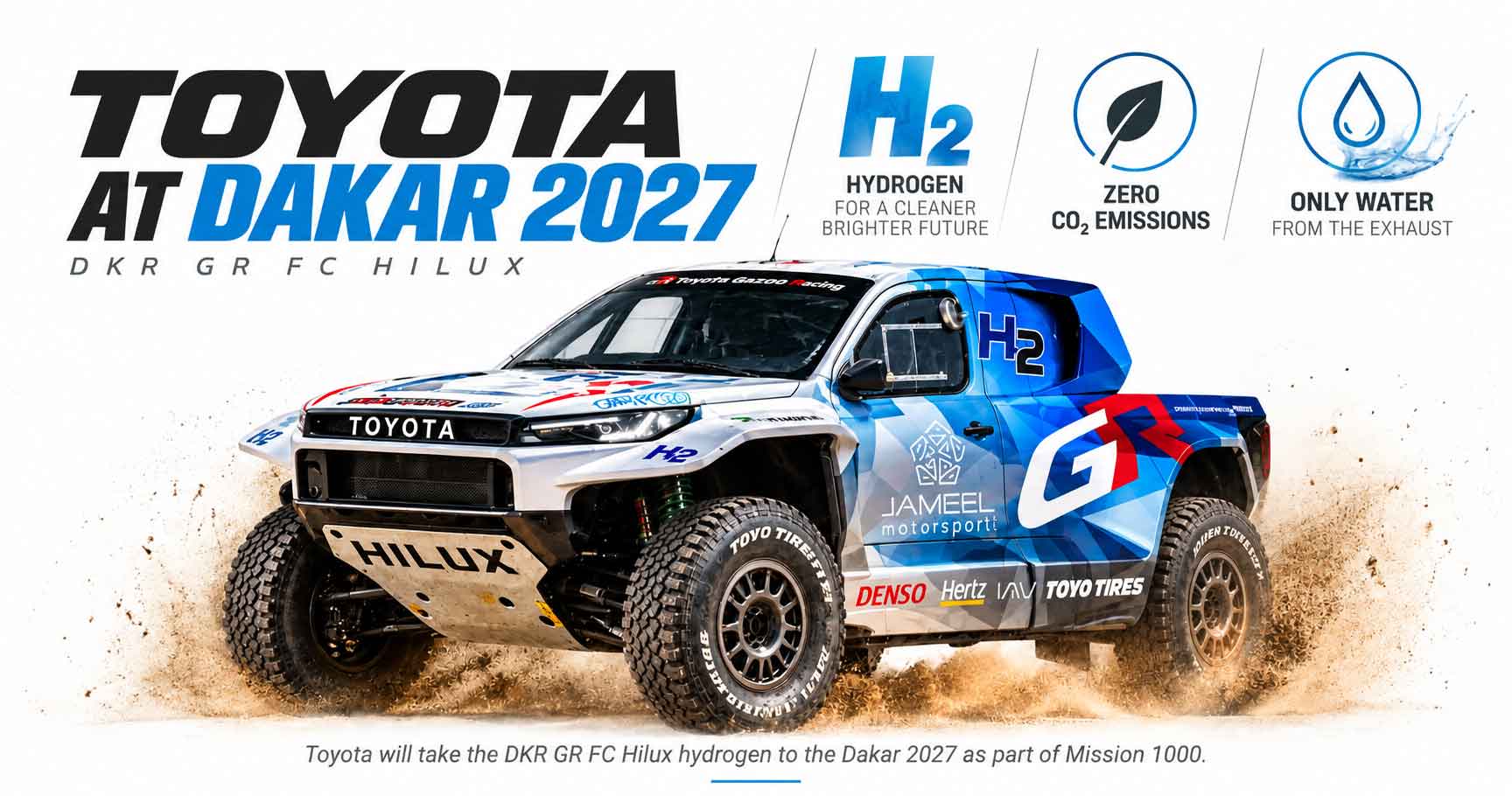
Toyota GAZOO Racing will bring a hydrogen fuel-cell electric Hilux to the 2027 Dakar. It will not compete for overall victory. Instead, it will cover 1,000 kilometres as part of Mission 1000, testing a technology that still has to prove it can withstand the extreme conditions of rally-raid competition.
In January, the Dakar will once again become much more than a race against the clock. Toyota GAZOO Racing has chosen Saudi Arabia to put one of its most ambitious technologies through a test that is difficult to replicate in a laboratory: 13 stages, sand, dust, extreme temperatures and 1,000 kilometres of competition.
The protagonist will be the DKR GR FC Hilux, a prototype based on Toyota’s Dakar Hilux, but with one fundamental difference: the petrol engine is replaced by an electric powertrain powered by a hydrogen fuel cell. That changes the purpose of the project completely.
This is probably the most important point for understanding the project. The DKR GR FC Hilux will not compete in the overall category against the vehicles fighting for Dakar victory. Toyota will enter it in Dakar Future Mission 1000, the category created for experimental vehicles and new technologies.
That also means it will not cover all the timed kilometres completed by the leading cars.
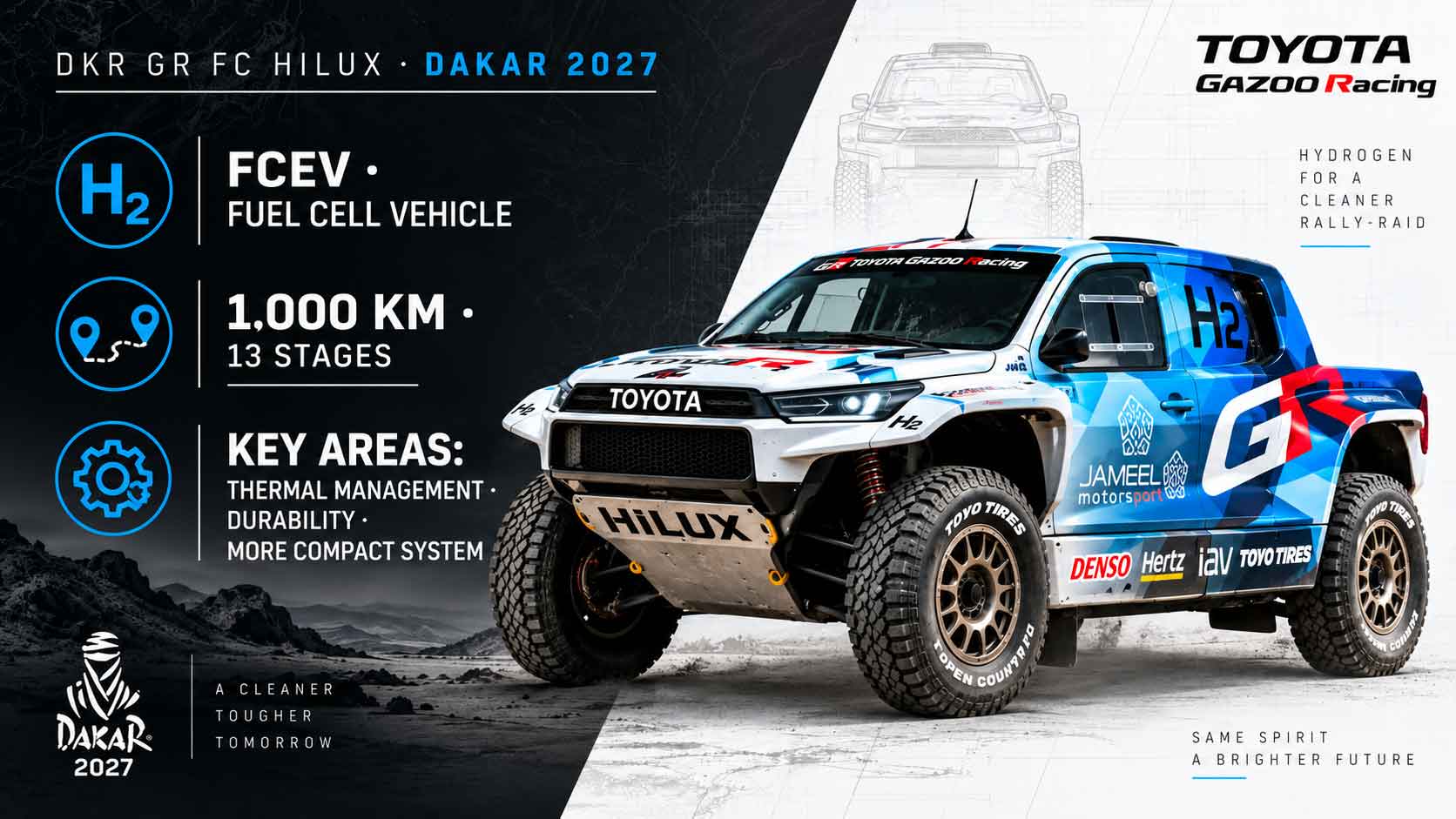
Its programme includes approximately 1,000 competitive kilometres across 13 stages.
The objective is different: to collect data and see how the hydrogen system performs outside a controlled development environment when exposed to Dakar conditions for several consecutive days.
Although it is often described as a “hydrogen Hilux”, there is an important distinction. This is not a combustion engine that burns hydrogen.
The DKR GR FC Hilux is an FCEV (Fuel Cell Electric Vehicle). Its fuel cell uses hydrogen to generate the electricity that powers the vehicle’s electric drivetrain.
Toyota says that while driving, there are no CO₂ emissions from the exhaust; the resulting emission is water. This is precisely the technology Toyota wants to test under extreme conditions.
This is one of the most interesting aspects of the project. Toyota said in July that development would focus particularly on three areas: reducing the size of the fuel-cell system, improving cooling and increasing durability.
The Dakar provides an especially demanding environment for the latter two. A competition vehicle must maintain performance for long periods, withstand constant vibrations and impacts, and operate in dust and sand while its mechanical and electrical systems are under heavy load.
Toyota therefore sees the project as more than an environmental demonstration. The company wants to test the technology’s performance, safety and reliability under real rally-raid conditions.
Toyota has not started the project from a blank sheet of paper. The prototype uses the DKR GR Hilux as its starting point, an architecture developed to compete in the Dakar’s top category.
On that platform, Toyota replaces the conventional powertrain with fuel-cell technology.
Development is taking place at Toyota’s European research and development centre near Brussels, and by mid-September the vehicle was still in the final assembly phase before beginning its pre-Dakar testing programme.
That puts the project into perspective: what we will see in January is still an experimental prototype under development, not a finished production vehicle.
The project also brings together several companies involved in its development and competition programme.
Jameel Motorsport, DENSO, TOYO TIRES and IAV are the official partners announced by Toyota for the programme. IAV, for example, will provide its Dragoon ECU and associated software for the project.
Their involvement also highlights another aspect of the programme. Mission 1000 is acting as a laboratory where manufacturers and suppliers can test technologies that are not yet ready to compete directly against conventional rally-raid vehicles.
This is where the project becomes particularly interesting beyond competition. Toyota has confirmed that it is preparing a production hydrogen fuel-cell Hilux for 2028.
The first targets announced for that model include more than 400 kilometres of range and a towing capacity of up to 2,500 kg.
That does not mean the Dakar prototype will directly become the production Hilux. They are separate projects.
But it does show that Toyota is developing this technology in parallel for real-world applications, while using competition to push certain components and solutions to their limits.
Toyota has not yet published several figures that would be particularly important for assessing the prototype’s real-world performance: hydrogen storage capacity, range per fill, consumption during the stages, power output and refuelling times.
That is where much of the technical interest will lie once testing begins. Making a vehicle run on hydrogen is only part of the challenge. In rally-raid, it must also carry enough energy, maintain performance over long distances and be refuelled within the complex logistics of the Dakar.
For now, Toyota has not disclosed these figures in its official communications.
The 2027 Dakar will take place in Saudi Arabia from 1 to 15 January, and the DKR GR FC Hilux will tackle a 13-stage programme within Mission 1000. Its times will not be the only thing worth watching.
Far more important will be whether it completes the programme, what problems emerge, how it manages temperature and range, and what changes Toyota makes after the experience.
Because in this case, the Dakar’s 1,000 kilometres will not decide who wins a race. They will show how far a hydrogen-powered competition Hilux can go today.